Pump System Certification (PSC) Level 1 On-Demand Bundle
-
Register
- Non-member - $1,400
- Member - $1,050
- Associate Member - $1,050
- Academic Partner - $1,330
- PSAP Industry Partner - $1,330
- Pump Industry Partner - $1,330
- Pump Industry Partner Retiree - $1,330
- Standards Partner - Consultant - $1,050
- Standards Partner - End User - $1,050
- Standards Partner - End User & Basic Training - $1,050
- Training Partner - $1,050

PSC Level 1 On-Demand Bundle
Professional Development Hours: 20.00
Overview:
The PSC Level 1 On-Demand Bundle provides individuals with training and exam preparation materials to advance their knowledge, capabilities and help them prepare for the PSC Level 1 Certification.
This bundle provided savings and convenience by packaging the recommended On-Demand training, exam preparation and PSC Level 1 Certification Exam in a single product at a discounted price. Review each product within the bundle for additional content details.
Content includes:
- Basic Pump & System Training On-Demand
- Pump System Certification (PSC) - Level 1: Exam Prep On-Demand
- PSC Level 1 Certification Exam
Learning Level - Basic:
Basic level training is designed for individuals who are new to the subject matter. It covers basic concepts, skills, and practices. Participants acquire a foundational understanding of the topic and develop basic competencies.
Audience:
- Individuals preparing for PSC Level 1 Certification.
- Early- to mid-career engineers.
- Technicians, operators, and mechanics with relevant experience.
- Technical sales and technical support professionals.
Core Capability:
A core capability following this training is the ability to understand how pumps, drivers, and systems interact, and to evaluate the effects of system conditions, operating changes, and control methods on pump performance, efficiency, power consumption, and reliability.
SKU:OD-PSC1-Bun
Registration Fees:
| Hydraulic Institute Member and Partner Types | Pricing |
| Member | $1,050.00 |
| Associate Member | $1,050.00 |
| Standards Partner | $1,050.00 |
| Training Partner | $1,050.00 |
| Industry Partner | $1,330.00 |
| Academic Partner | $1,330.00 |
| Non-Member | $1,400.00 |
Members, Associate Members, Standards Partners, and Training Partners of the Hydraulic Institute (HI) receive 25% discount on all available PSM training. Employees of Members, Associate Members, Standards Partner, and Training Partner organizations must log-in with their company email address in order for the discounted registration fee to apply. Industry Partners and Academic Partners receive 5% discount on all PSM training.
Membership Question? Call us at 973-267-9700, email us, or view the HI website for more information about membership benefits.
Refunds:
All refund requests must be made in writing at [email protected].
Professional Development Hours (PDH):
Upon the successful completion of this on-demand content, you will receive a Certificate of Completion for the number of credit hours noted on the "Overview" tab.
Note: 1.0 PDHs is equivalent to 0.10 CEUs or 1.0 Contact Hours
Licensed Professional Engineers:
Continuing professional development is a vital component of the engineering licensure process. Most state licensing boards require continuing professional development as a condition for licensure and renewal of the license to practice engineering. The acceptance of continuing education as it applies to fulfillment of the state licensing requirements for professional designations is at the pleasure of the individual state licensing boards. It is the responsibility of the individual participants to be knowledgeable about their state requirements. Pre-approval of training providers and courses is not required by most state licensing boards, except for the following:
Florida Board of Professional Engineers
Pump Systems Matter is a board-approved continuing education provider for the Florida Board of Professional Engineers: License # CEA361.
New York State Board for Engineering, Land Surveying, and Geology
Pump Systems Matter is approved as a sponsor of continuing education for professional engineers in New York State: NYS Sponsor # 241.
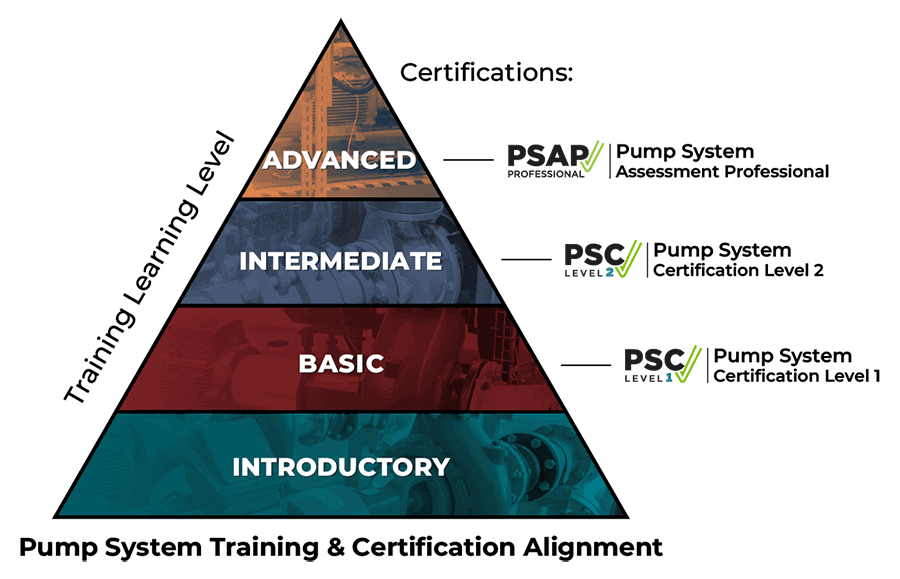
The Hydraulic Institute (HI) has developed three certifications: Pump System Certification – Level 1 (PSC Level 1), Pump System Certification – Level 2 (PSC Level 2), and the Pump System Assessment Professional (PSAP). Each certification level includes 16 standard knowledge domains but the knowledge topics within each domain have logical progression from understand and apply (Level 1), to interpret and analyze (Level 2), to evaluate and solve (PSAP).
Pump Systems Matter (PSM) has created an aligned training catalog. As outlined in the Pump System Training and Certification Alignment Pyramid below, each training product is assigned to a Learning Level that corresponds with the certification level. This creates a cohesive and structured learning pathway.
-
Contains 128 Component(s), Includes Credits
This training covers broad topics that will benefit anyone that deals with pumps or pump systems. Learn about pump and system types, pump and system curves, important components and construction details, selection considerations and more. Attendees will leave with increased pump and system knowledge and essential skills paving the way to advancing their career. SKU: OD-PSC1-T
Basic Pump & System Training On-Demand
Professional Development Hours: 16.0
Overview:
The Basic Pump & System Training On-Demand covers 16 domains aligned with Pump System Certification Level 1 (PSC Level 1). Each domain training starts with introductory level topics and progresses to basic level topics. Presented in multiple short modules followed by quizzes to reinforce the stated learning objectives allows students to progress at their own pace.
This training covers broad topics that will benefit anyone that deals with pumps or pump systems. Learn about pump and system types, pump and system curves, important components and construction details, selection considerations and more. Attendees will leave with increased pump and system knowledge and essential skills paving the way to advancing their career.
Learning Path:
- Suggested prior to enrolling in the Intermediate Pump & System Training.
- Recommended preparatory training for individuals pursuing Pump System Certification (PSC) Level 1.
Click here for the full PSC Level 1 Certification training and preparation recommendations.
Learning Level - Basic:
Basic level training is designed for individuals who are new to the subject matter. It covers basic concepts, skills, and practices. Participants acquire a foundational understanding of the topic and develop basic competencies.
Audience:
- Operators, technicians, and maintenance personnel.
- Entry-level to mid-career engineers.
- Technical sales and technical support professionals.
- Employees onboarding into pump or pumping system-related roles.
Core Capabilities:
A core capability following this training is the ability to understand how pumps, drivers, and systems interact, and to evaluate the effects of system conditions, operating changes, and control methods on pump performance, efficiency, power consumption, and reliability.
SKU: OD-PSC1-T
Learning Objectives:
Participants will be able to:
- Identify rotodynamic and positive displacement pump types and describe their typical applications.
- Read and interpret pump performance curves and explain how the affinity rules affect pump performance.
- Determine pump power and calculate efficiency using performance data and operating conditions.
- Explain pump system fundamentals, including system curves, operating point, pressure, head, friction losses, NPSH/NPIP, and cavitation.
- Describe the influence of specific speed and operating region on rotodynamic pump performance.
- Recognize common driver and drive characteristics, including motor types, starting methods, and variable frequency drives (VFDs).
- Identify major pump components, sealing methods, bearings, couplings, and system control devices, and explain their basic functions.
- Apply basic pump selection principles, including impeller trimming and series and parallel operation.
- Describe factory performance testing, acceptance grades, and common test arrangements at a high level.
- Recognize basic installation, commissioning, startup, and maintenance practices.
- Identify common operating problems and apply basic pump system analysis concepts, including life cycle cost and pump system optimization, to support troubleshooting discussions.
Outline:
Domain 1: Introduction to Pumps
- Pump and System Major Components.
- Pump Classifications.
- Rotodynamic Pump Types, Classifications, and Application Considerations.
- Positive Displacement Pump Types, Classifications, and Application Considerations.
Domain 2: Pump Performance Curves and Power Consumption
- Pump Performance Curves.
- Pump Performance Curves: Understanding the Basics and Information Plotted.
- Power and Efficiency.
- Affinity Rules.
Domain 3: Pump Systems
- Pumps and Pumping Systems.
- System Curve and Operating Point.
- Fluid Properties Affecting Pump Performance.
- Pressure & Head.
- Friction Losses.
- NPSH & Cavitation.
- Factors that Affect the Pump AOR.
Domain 4: Rotodynamic Pump Designs and Types
- Rotodynamic Pumps and Specific Speed.
- Characteristics of Rotodynamic Pump Types.
- Common Rotodynamic Pump Components.
Domain 5: Positive Displacement Pump Designs and Types
- Hydraulic Performance and Common Pump Components.
- Reciprocating Pumps.
- Rotary Pumps.
- Pump Affinity Rules and Power Consumption.
- Materials of Construction and Pressure Relief Valves.
Domain 6: Pump Components and Accessories
- The Pump Nameplate and Static Sealing Methods.
- Compression Packing and Mechanical Seals.
- Bearings and Bushings.
- Couplings, Drive Shafts, and Gears.
Domain 7: Drivers and Drives
- Pump Driver Types.
- Electrical Parameters and Applicable Driver Standards.
- Motor Types, Enclosures, and Frame Sizes.
- Motor Starting Methods and Variable Frequency Drives (VFDs).
Domain 8: System Design Considerations
- System Design Standards and Major System Components.
- Pump System Controls and Instrumentation.
Domain 9: Varying and Pump Operating Point
- The Operating Point.
- Affinity Rules for Speed and Impeller Diameter.
- Control Methods.
- Impeller Trimming.
- Pump Performance Curve.
- Parallel and Series Pumping.
Domain 10: Pump Selection and Specification
- Pump Selection and Specification.
Domain 11: Testing
- Factory Performance Testing.
- NPSH, NPIP, and Hydrostatic.
- Factory Performance Test Acceptance Grades.
- Typical Factory Performance Test Arrangements.
Domain 12: Pump Installation, Commissioning and Startup
- Site Drawings.
- IOM Manuals.
- Basic Installation, Priming, and Startup.
Domain 13: Maintenance
- Safety Considerations and Calibration of Instrumentation.
- Basic Maintenance Practices.
- Basic Pump Maintenance.
Domain 14: Troubleshooting
- Troubleshooting Common Operating Problems.
Domain 15: Pump System Optimization and Analysis
- Life Cycle Cost (LCC).
- Pump System Optimization (PSO).
Domain 16: Markets and Applications
- Pump Industry Market Segments and Applications.
Registration Fees:
Hydraulic Institute Member and Partner Types Pricing Member $750.00 Associate Member $750.00 Standards Partner $750.00 Training Partner $750.00 Industry Partner $950.00 Academic Partner $950.00 Non-Member $1,000.00 Members, Associate Members, Standards Partners, and Training Partners of the Hydraulic Institute (HI) receive 25% discount on all available PSM training. Employees of Members, Associate Members, Standards Partner, and Training Partner organizations must log-in with their company email address in order for the discounted registration fee to apply. Industry Partners and Academic Partners receive 5% discount on all PSM training.
Membership Question? Call us at 973-267-9700, email us, or view the HI website for more information about membership benefits.
Volume Discount:
Receive volume discounts up to 20% off on select training and certification products. Create an account (or login if you have one), and add products to the cart to see the applicable discounts. Member and partner discounts are combined with volume pricing for additional savings.
Refunds:
All refund requests must be made in writing at [email protected].
- Slide Decks for Each Domain Training
- On-Demand Training and Quizzes for each Domain Module
Professional Development Hours (PDH):
Upon the successful completion of this on-demand content, you will receive a Certificate of Completion for the number of credit hours noted on the "Overview" tab.
Note: 1.0 PDHs is equivalent to 0.10 CEUs or 1.0 Contact Hours
Licensed Professional Engineers:
Continuing professional development is a vital component of the engineering licensure process. Most state licensing boards require continuing professional development as a condition for licensure and renewal of the license to practice engineering. The acceptance of continuing education as it applies to fulfillment of the state licensing requirements for professional designations is at the pleasure of the individual state licensing boards. It is the responsibility of the individual participants to be knowledgeable about their state requirements. Pre-approval of training providers and courses is not required by most state licensing boards, except for the following:
Florida Board of Professional Engineers
Pump Systems Matter is a board-approved continuing education provider for the Florida Board of Professional Engineers: License # CEA361.
New York State Board for Engineering, Land Surveying, and Geology
Pump Systems Matter is approved as a sponsor of continuing education for professional engineers in New York State: NYS Sponsor # 241.
The Hydraulic Institute (HI) has developed three certifications: Pump System Certification – Level 1 (PSC Level 1), Pump System Certification – Level 2 (PSC Level 2), and the Pump System Assessment Professional (PSAP). Each certification level includes 16 standard knowledge domains but the knowledge topics within each domain have logical progression from understand and apply (Level 1), to interpret and analyze (Level 2), to evaluate and solve (PSAP).
Pump Systems Matter (PSM) has created an aligned training catalog. As outlined in the Pump System Training and Certification Alignment Pyramid below, each training product is assigned to a Learning Level that corresponds with the certification level. This creates a cohesive and structured learning pathway.
HI 41.8 Program Guideline for Pump System Certification: This program guideline establishes the formal credentialing requirements for a Pump System Certified (PSC) Level 1 and Level 2 certification, including a standardized examination and renewal process. The certification provides third-party validation by the Hydraulic Institute (HI) that individuals have the knowledge, training, and experience necessary to understand and apply core pump system fundamental knowledge.
Pump Industry Fundamentals Body of Knowledge (BOK): The Pump Industry Fundamentals Body of Knowledge covers general pump system fundamental knowledge requirements (learning outcomes) that should be common across job functions and industries.
The HI Data Tool: The HI Data Tool is a comprehensive guide for pump users, pump manufacturers and engineers in need of references for pump principles, calculations, and unit conversions.
World Without Pumps: This fun and relatable recruitment piece brings light to the hidden world of pumps and the positive impact they have on our everyday lives and society.
Pump Pros Know: What do pump pros know and why do they know it? This series of articles highlight the brilliance of those who work with pumps.
-
Contains 39 Component(s), Includes Credits
The Pump System Certification Level 1 (PSC Level 1) Exam Prep on-demand provides concise overviews and domain-specific challenge questions for each certification domain. This product supports candidates pursuing PSC Level 1 Certification by reviewing each domain and offering realistic domain challenges and practice exam questions. Instructional training for each domain is not included. SKU: OD-PSC1-P

Pump System Certification (PSC) - Level 1
Exam Prep On-Demand
Professional Development Hours: 4.0Overview:
The Pump System Certification Level 1 (PSC Level 1) Exam Prep on-demand product provides concise overviews and domain-specific challenge questions for each certification domain. Full-length practice exams are included, with explained answers designed to reinforce key concepts and familiarize participants with the exam format. This product supports candidates pursuing PSC Level 1 Certification by reviewing each domain and offering realistic domain challenges and practice exam questions. Instructional training for each domain is not included.
Participants seeking formal training in addition to exam preparation may find it here.
Learning Level: Basic
Basic level training is designed for individuals who are new to the subject matter. It covers basic concepts, skills, and practices. Participants acquire a foundational understanding of the topic and develop basic competencies.
Audience:
- Individuals preparing for PSC Level 1 Certification.
- Early- to mid-career engineers.
- Technicians, operators, and mechanics with relevant experience.
- Technical sales and technical support professionals.
SKU: OD-PSC1-P
Outline:
Pump System Certification (PSC) - Level 1 Overview
Domain 1: Introduction to Pumps
- Overview
- Domain knowledge challenge.
Domain 2: Pump Performance Curves and Power Consumption
- Overview
- Domain knowledge challenge.
Domain 3: Pump Systems
- Overview
- Domain knowledge challenge.
Domain 4: Rotodynamic Pump Designs and Types
- Overview
- Domain knowledge challenge.
Domain 5: Positive Displacement Pump Designs and Types
- Overview
- Domain knowledge challenge.
Domain 6: Pump Components and Accessories
- Overview
- Domain knowledge challenge.
Domain 7: Drivers and Drives
- Overview
- Domain knowledge challenge
Domain 8: System Design Considerations
- Overview
- Domain knowledge challenge.
Domain 9: Varying the Pump Operating Point
- Overview
- Domain knowledge challenge.
Domain 10: Pump Selection and Specification
- Overview
- Domain knowledge challenge.
Domain 11: Testing
- Overview
- Domain knowledge challenge.
Domain 12: Pump Installation, Commissioning and Startup
- Overview
- Domain knowledge challenge.
Domain 13: Maintenance
- Overview
- Domain knowledge challenge.
Domain 14: Troubleshooting
- Overview
- Domain knowledge challenge.
Domain 15: Pump System Optimization and Analysis
- Overview
- Domain knowledge challenge.
Domain 16: Markets and Applications
- Overview
- Domain knowledge challenge.
Sample Certification Exam
The exam preparation on-demand product includes a sample certification exam drawn from a question bank containing 140 questions with explained answers. The full-length sample exam selects 100 randomized questions from the question bank and allows unlimited attempts. Because the questions are randomized, participants may take an unlimited number of full-length sample exams without repeating the same version and can review their results along with explained answers after each attempt.
While there is no time limit set, the suggested duration is no more than 3 hours to imitate the exam duration.
Registration Fees:
Hydraulic Institute Member and Partner Types Pricing Member $187.50 Associate Member $187.50 Standards Partner $187.50 Training Partner $187.50 Industry Partner $237.50 Academic Partner $237.50 Non-Member $250.00 Members, Associate Members, Standards Partners, and Training Partners of the Hydraulic Institute (HI) receive 25% discount on all available PSM training. Employees of Members, Associate Members, Standards Partner, and Training Partner organizations must log-in with their company email address in order for the discounted registration fee to apply. Industry Partners and Academic Partners receive 5% discount on all PSM training.
Membership Question? Call us at 973-267-9700, email us, or view the HI website for more information about membership benefits.
Volume Discount:
Receive volume discounts up to 20% off on select training and certification products. Create an account (or login if you have one), and add products to the cart to see the applicable discounts. Member and partner discounts are combined with volume pricing for additional savings.
Refunds:
All refund requests must be made in writing at [email protected].
- Knowledge challenge for each domain, with explained answers following completion.
- Full-length sample certification exam, with explained answers following completion.
- PDF of Slide Decks for all domain overview videos.
Professional Development Hours (PDH):
Upon the successful completion of this on-demand content, you will receive a Certificate of Completion for the number of credit hours noted on the "Overview" tab.
Note: 1.0 PDHs is equivalent to 0.10 CEUs or 1.0 Contact Hours
Licensed Professional Engineers:
Continuing professional development is a vital component of the engineering licensure process. Most state licensing boards require continuing professional development as a condition for licensure and renewal of the license to practice engineering. The acceptance of continuing education as it applies to fulfillment of the state licensing requirements for professional designations is at the pleasure of the individual state licensing boards. It is the responsibility of the individual participants to be knowledgeable about their state requirements. Pre-approval of training providers and courses is not required by most state licensing boards, except for the following:
Florida Board of Professional Engineers
Pump Systems Matter is a board-approved continuing education provider for the Florida Board of Professional Engineers: License # CEA361.
New York State Board for Engineering, Land Surveying, and Geology
Pump Systems Matter is approved as a sponsor of continuing education for professional engineers in New York State: NYS Sponsor # 241.
The Hydraulic Institute (HI) has developed three certifications: Pump System Certification – Level 1 (PSC Level 1), Pump System Certification – Level 2 (PSC Level 2), and the Pump System Assessment Professional (PSAP). Each certification level includes 16 standard knowledge domains but the knowledge topics within each domain have logical progression from understand and apply (Level 1), to interpret and analyze (Level 2), to evaluate and solve (PSAP).
Pump Systems Matter (PSM) has created an aligned training catalog. As outlined in the Pump System Training and Certification Alignment Pyramid below, each training product is assigned to a Learning Level that corresponds with the certification level. This creates a cohesive and structured learning pathway.
HI 41.8 Program Guideline for Pump System Certification: This program guideline establishes the formal credentialing requirements for a Pump System Certified (PSC) Level 1 and Level 2 certification, including a standardized examination and renewal process. The certification provides third-party validation by the Hydraulic Institute (HI) that individuals have the knowledge, training, and experience necessary to understand and apply core pump system fundamental knowledge.
Pump Industry Fundamentals Body of Knowledge (BOK): The Pump Industry Fundamentals Body of Knowledge covers general pump system fundamental knowledge requirements (learning outcomes) that should be common across job functions and industries.
The HI Data Tool: The HI Data Tool is a comprehensive guide for pump users, pump manufacturers and engineers in need of references for pump principles, calculations, and unit conversions.
World Without Pumps: This fun and relatable recruitment piece brings light to the hidden world of pumps and the positive impact they have on our everyday lives and society.
Pump Pros Know: What do pump pros know and why do they know it? This series of articles highlight the brilliance of those who work with pumps.
-
Contains 8 Component(s)
Pump System Certification (PSC) Level 1 certification validates that individuals are competent on the core knowledge areas for pump and pump systems, provides a solid foundation for new and early-career individuals, and serves as a benchmark on the fundamentals for the pump and fluid handling industry.
PSC Level 1 Certification Exam
Overview:
The Pump System Certification (PSC) was developed by the Hydraulic Institute to provide third-party validation that individuals have the knowledge, training, and experience necessary to apply general pump system fundamental knowledge. This industry certification is for new or entry-level technical and non-technical persons and is applicable to all jobs functions within the fluid handling industry. For examples of the types of jobs available in the industry, please go visit the HI Workforce Development website. Recommended training for the certification can be found by clicking here.
Eligibility Requirements:
To be eligible for the PSC Level 1 certification, Applicants must be enrolled in or graduated from an associate degree or bachelor’s degree program, preferred in an engineering or technical field, or have at least six (6) months of related experience. There is no minimum training hours required, but it is recommended.
Description:
The PSC Level 1 validates that successful candidates have competencies that include, but are not limited to:
- In-depth knowledge of pump curves, system curves, and their interaction.
- Identifying all types of pumps along with the extended pump product.
- Understanding the basic operating theory of both rotodynamic and positive displacement pumps.
- Recognizing major pump components, terminology, and understanding their purpose.
- Performing basic pump industry calculations, such as power calculations and annual energy consumption.
- Understanding different fluid properties.
- Describing and applying basic concepts of variable speed pumping and control.
- Understanding the causes of common operating problems.
- Understanding basic installation, maintenance, and operation principles.
- Determining typical application considerations.
- Basic understanding of vibration analysis.
- Understanding pump curves as a tool to troubleshoot pump performance issues.
Candidates have two and a half (2.5) hours to complete the certification exam. Carefully read the questions and choose the best answer. A formula sheet has been provided as a reference.
For more information on the certification process and the exam, please go to www.pumps.org/psc.
Remote Proctoring Standard Rules
HI offers remote online-proctored exams as a safe, secure, and easy way to take the certification exam via MonitorEDU. To learn more about how the remote exam proctoring works, go to www.monitoredu.com/faq.
Permitted Materials
Candidates are allowed to have the following materials while taking the certification exam:
- Scientific calculator.
- White board/sheet with marker/eraser.
- HI issued formula reference sheet (printed or on-screen).
Room Requirements
- The exam must be taken in a private room with no other individuals present.
- No external cameras are allowed except those used for proctoring.
- Bookcases should be covered to prevent hidden cameras.
- The room should be organized and free of clutter.
- The space must be well-lit with no glare from sunlight or artificial lighting.
- The environment must be quiet—no background noise, including music, television, or conversations.
Desk & Testing Area Requirements
- The test must be taken on a hard, flat surface, such as a desk, table, or counter.
- The candidate must sit on a chair, bench, or another hard, flat surface.
- Testing on beds, sofas, or recliners is prohibited, as these areas allow for concealed materials.
- The test area must remain free of clutter.
- Only authorized materials and aids are permitted.
- Any permitted materials must be visible to the proctor at all times.
- Beverages must be in a clear or plain container.
Candidate Appearance & Attire
- Candidates must wear plain clothing with no visible logos or text.
- Hats and hoodies are not permitted, except for religious purposes - but we will still inspect the ears for prohibited items (see below)
- No smart glasses, electronic eyewear, or wearable technology.
- No jewelry except for relationship rings.
- No watches, wristbands, or fitness trackers.
- No headphones, earbuds, or listening devices of any kind.
Candidate Behavior During the Exam
- No talking or reading questions aloud.
- Candidates must remain focused on the exam at all times.
- No smoking, vaping, or tobacco use during the exam.
- The candidate must not leave the testing area until the exam is submitted.
Other Rules & Compliance
- Candidates must follow all instructions from the proctor.
- Professional conduct is required at all times.
Technology & Equipment Restrictions
- Dual monitors are not allowed.
- The placement of the phone for proctoring must follow the proctor’s instructions to ensure a clear view of the testing environment, the candidate, and the device the candidate is testing on.
Please contact us at [email protected] for any questions on proctoring the certification exam.